What is DevOps?
Software teams have a new way to collaborate


There is a positive buzz about DevOps among Tech companies, and not without reason. What is DevOps? DevOps is the new and improved way for tech companies to build and deliver software.
Dev and Ops - The traditional way
In a traditional setup, there are two teams that are responsible for building and delivering software to customers - the developers (who write the code) and the IT operations team (who deploy and maintain that code in a production environment). And these teams have worked in silos and haven’t played well with each other. Since the teams worked independently, it often led to yawning gaps and deep conflict between the two departments.
DevOps - The new way
DevOps is a combination of two words: Development (Dev) and Operations (Ops). DevOps is the modern approach to help software developers and IT operations work better and faster, together. It is a shift in the working philosophy between the two areas. DevOps signals a newer era of efficient collaboration.
In companies that follow DevOps practices, the developers and operations guys work together from the beginning. The emphasis is on collaboration between the teams. This means that people in both teams are concerned about each other's work. The developers are concerned about how the code is deployed to servers and the operations are concerned about the development.
Benefits of DevOps
When the teams collaborate in this way, it results in many benefits. It reduces the development cycle. The bug fixes and new features built by the dev team are deployed faster and more smoothly, sometimes multiple times a day. DevOps relies heavily on automation. Since the teams are collaborating, many things can be automated. For example, changes in code can be tested automated and made ready for deployment. This is a part of the Continuous Integration (CI) pipeline.
Continuous Integration is the practice of regularly merging code changes from all developers on a team into a main codebase. This process happens frequently, often multiple times per day, and it's accompanied by automated builds and tests to ensure that new changes don't break existing functionality.
Similarly, many parts of deployment can also be automated. This is commonly referred to as Continuous Deployment (CD). This allows for faster, more frequent deployments.
In Continuous Deployment, every change that passes all stages of your production pipeline is released to your users automatically. This is achieved through rigorous automated testing that ensures that you're only deploying quality code.
The DevOps Cycle
The DevOps cycle is a set of stages that software goes through during development. Since DevOps is a philosophy and a set of practices, these stages are not set in stone and can be different in different companies. The DevOps stages are represented by a very interesting symbol called Infinity Loop, which emphasizes that the process of software development and delivery is ongoing and cyclical, rather than linear.
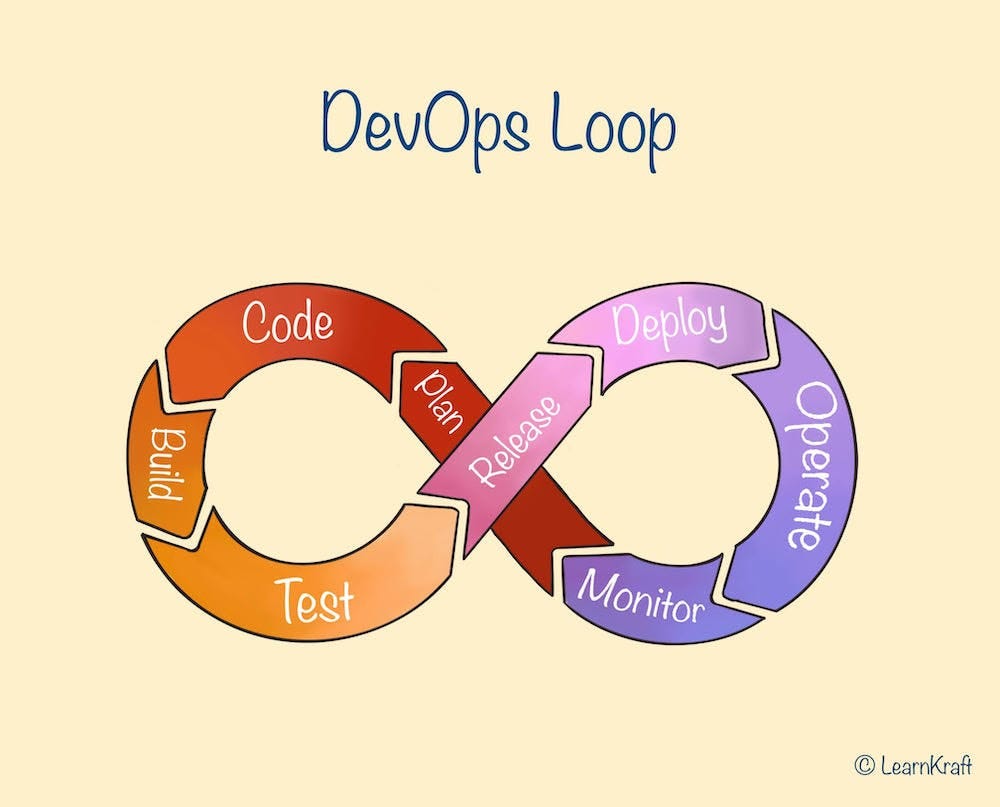
Let’s briefly look at these stages:
Plan: In stage involves planning new features and enhancements, creating specifications, and allocating resources for executing these changes.
Code: In this stage, the developers write code for implementing the new features and improvements.
Build: In this stage, the new code is prepared for production and is transformed into a form that can be deployed to servers or delivered to users. This process often involves the use of Continuous Integration (CI) tools that automate compiling the code, resolving dependencies, and packaging all components. For instance, for a mobile app, CI would include creating a new version of the app. For a web app, it's about making a deployable format that can be executed on a server. CI ensures this build process is consistent and errors are caught early.
Test: In this stage, the new version of the software is tested to make sure it works correctly and meets the project's requirements.
Release: If the tests are successful, the new version of the software is prepared for release. This often involves uploading the new version in a staging environment that closely resembles the live environment.
Deploy: The new version of the software is deployed to the live environment, replacing the old version. Deployment is often automated in a process called continuous deployment.
Operate: The software is run in the live environment, where it is used by end users.
Monitor: The operation of the software is continuously monitored to ensure it is working correctly and efficiently. Any problems are reported back to the team.
Common Misconceptions
Let’s look at some common doubts about DevOps.
Q: Is DevOps just about tools and technology?
A: No, DevOps isn't just about tools. While tools play an important role, DevOps is a cultural shift focusing on team collaboration.
Q: Is DevOps only for tech companies or startups?
A: Not at all! Any organization that creates software can benefit from DevOps, from banks and healthcare providers to government agencies.
Q: Does implementing DevOps mean we get rid of our operations team?
A: No way! DevOps is about getting developers and operations to work together, not removing operations. Both roles remain critical, but they collaborate more to streamline the process of delivering software.
Q: Is DevOps a job role or a team within a company?
A: DevOps is more of a culture or a way of working, rather than a specific role or team. Although some firms have a 'DevOps team', it's mainly about embracing the DevOps values of teamwork and automation throughout all development and operations tasks.
To conclude, DevOps is a way of working that emphasizes collaboration between the teams that create software and the teams that ensure the software is delivered and works well. It promotes quick feedback, constant improvement, and automation, aimed at delivering software faster, with higher quality and reliability.